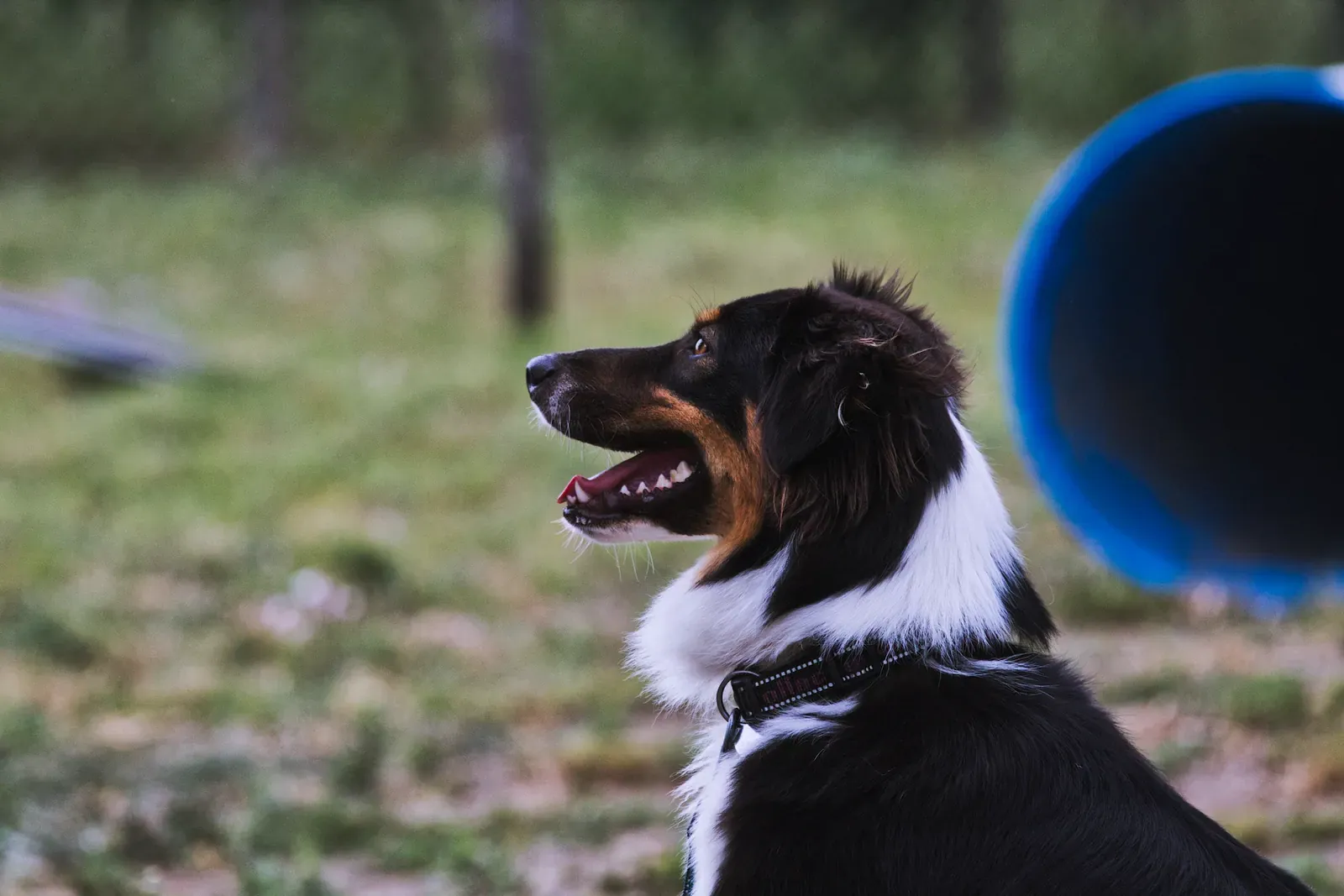
Nipping heels, chasing bikes, staring at shadows, fear of noise and wrecked sofas are usually working instincts, stress or boredom showing up at home. They respond best to daily exercise plus mental work, early and reward-based training. This guide helps current and future Border Collie owners understand each common problem, fix what can be fixed at home, and spot when a vet or behaviourist is needed.
For history and temperament see the Border Collie profile. In short: the breed keeps the first steps of the wolf hunting sequence (watch, stare, stalk) and was bred to skip the last ones, so movement triggers it very easily.
Jump to a problem
Quick answer: what do Border Collies need to behave well?
- Exercise. The Kennel Club gives more than two hours of activity a day. Walks alone rarely tire a working-type dog.
- Mental work. Short training sessions, scent games, tricks and sport. Ten minutes of thinking often tires the dog more than half an hour of ball throwing.
- Rest. A dog never taught to settle often does not settle on its own.
- Careful early socialisation to people, surfaces, sounds and animals.
- Reward-based training. Food, play and praise for what you want, calm management of what you do not.
- A vet check first when behaviour is sudden, extreme or repetitive. Pain and illness can look like "bad behaviour".
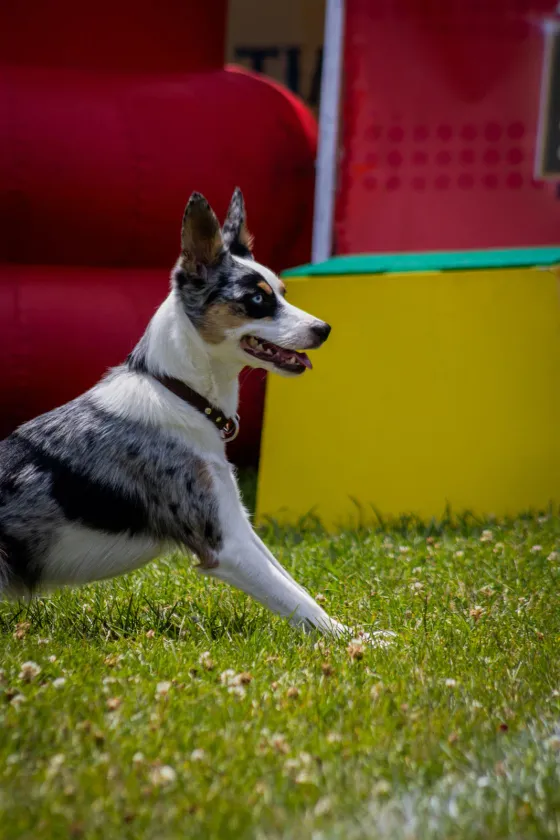
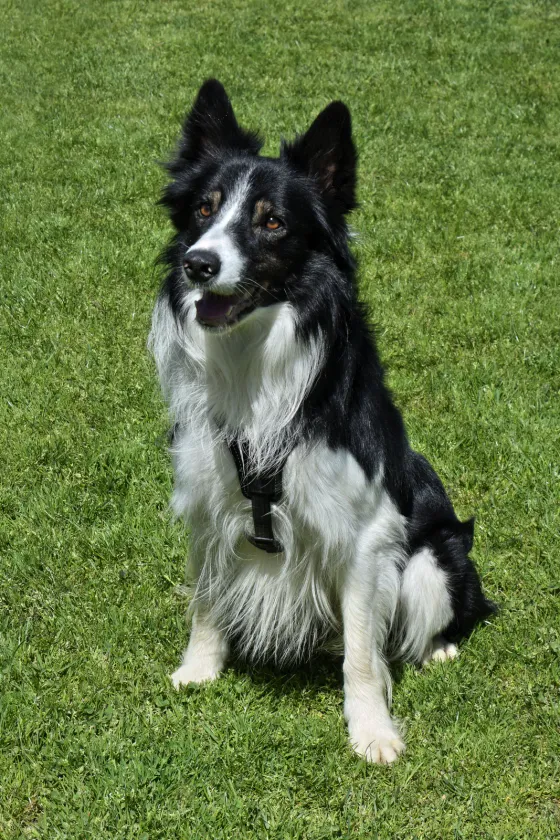
How much exercise and mental work does a Border Collie need?
It depends on the line: trial-bred dogs are usually more intense than show or pet lines. Plan for around two hours of activity in parts (walk, training session, second outing, evening game). Puppies and adolescents need shorter sessions while joints develop, so ask your vet about limits before hard running or jumping.
Beware the fitness spiral: the more you run the dog, the fitter and more demanding it gets. Swap some fast repetition for sniffing walks, scatter feeding, food puzzles and short training sessions.
How do you teach a Border Collie to switch off?
An off-switch is a skill. Teach it from the first week home.
- Put a mat in a quiet corner of the room where the family sits.
- Reward the dog for lying on it, first for seconds, then longer. Drop treats between its paws without talking.
- Add a cue word once the dog goes to the mat and lies down reliably.
- Add distractions in small steps: someone walking past, a door opening.
- Use a crate or pen for rest if the dog is comfortable in it, introduced with food and never as punishment.
Over-tired dogs get wired and snappy. A planned quiet hour helps many.
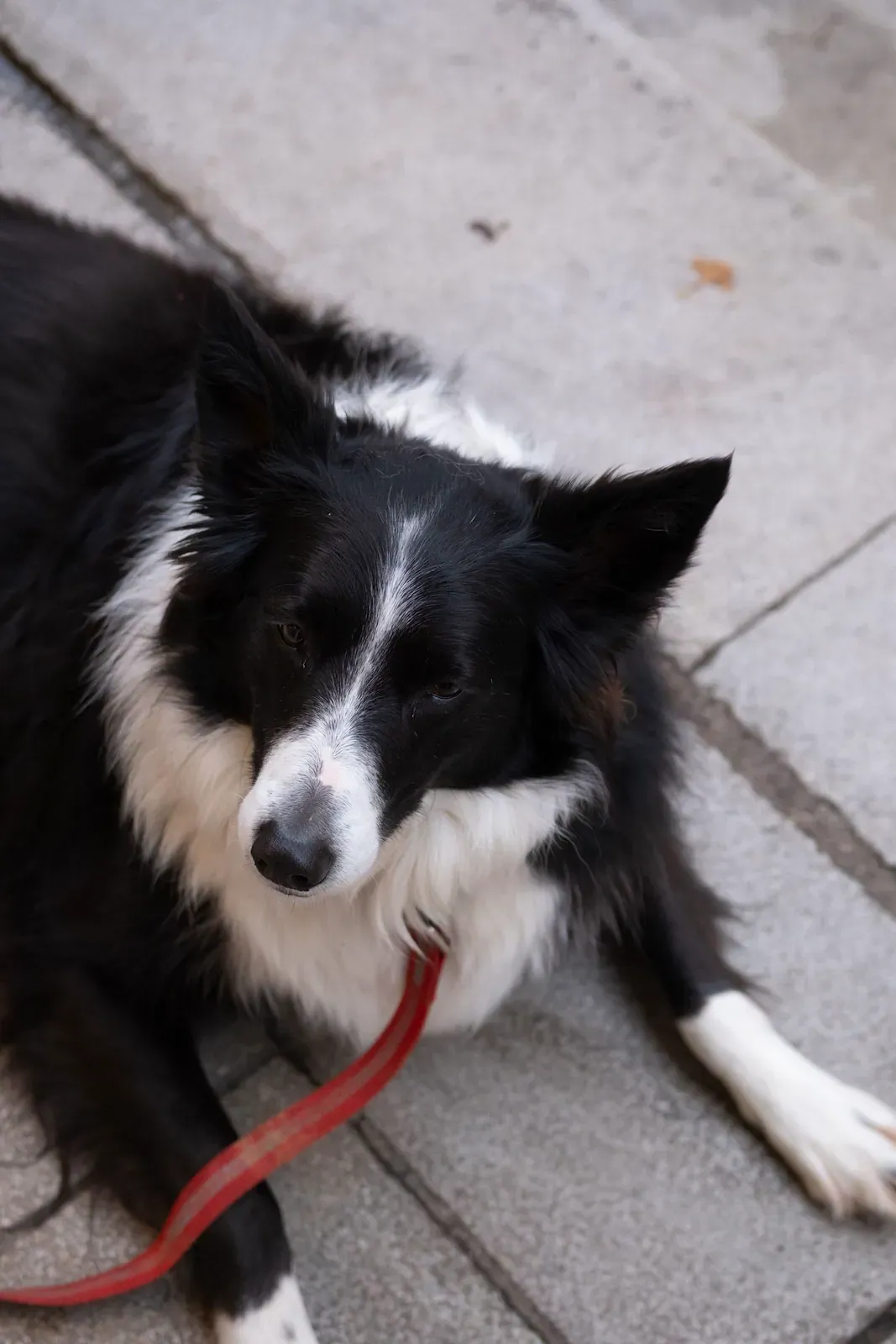

Why does my Border Collie nip at heels, children and visitors?
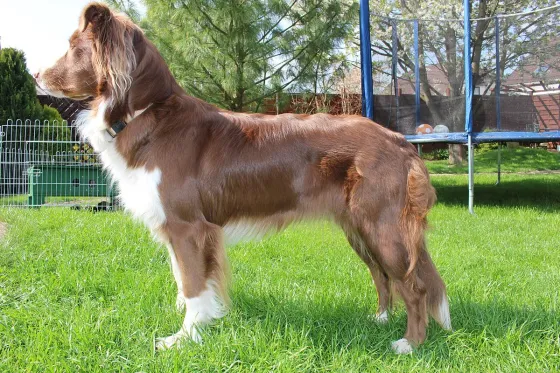
What it looks like. The dog circles, crouches, stares, then nips at heels, trouser legs or the hands and feet of running children.
Why. Heading and nipping are the tools the dog was bred to use on stock. A running child behaves like a sheep that will not stay put: fast, erratic, high-pitched. The instinct fires before any thought. It is a herding behaviour, usually not aggression, but it can hurt and frighten a child. Puppies also mouth hands while teething.
What to do.
- Manage first. Never leave a Border Collie unsupervised with young children. Use gates, a pen or a closed door.
- Interrupt calmly. Call the dog away or ask for a known cue such as "sit". Shouting and chasing make it a game.
- Reward calm around movement. Have a helper walk or jog past at a distance. Pay the dog for looking at you or lying down, then close the distance slowly over many sessions.
- Teach children the rules: no running, screaming or grabbing near the dog, and leave a resting dog alone.
- Give a proper outlet. A dog that has worked that day has less need to herd the family.
When to get help. If the dog breaks skin, growls over food or space, or the nipping intensifies, see your vet, then a qualified behaviourist.
A UK study of about 3,900 dog owners found that puppy classes were linked to lower risk of aggression to unfamiliar people, while training with positive punishment or negative reinforcement was linked to higher risk (Casey et al., 2014).
Why does a Border Collie chase cars, bikes and joggers?
What it looks like. Staring, lunging, barking and running at fast-moving things, often along a fence or on the lead.
Why. Motion is the . Stalking and chasing are the working sequence, and a passing bike has the pace of a runaway sheep. Chasing is rewarding in itself: the dog lunges, the object leaves, the dog "wins". Practice makes it stronger.
What to do.
- Safety first. Chasing vehicles can kill the dog or cause a crash. Keep a lead on, or a secure fence, wherever traffic or bikes pass.
- Use distance. Find the distance at which the dog sees the trigger without reacting. Reward each look at the trigger followed by a look at you. Reduce distance over weeks.
- Teach a turn. On the lead, stop, turn away and move off together, paying every step.
- Redirect to a job. A tug toy or a trained "find it" gives the dog something else to do when the trigger appears.
When to get help. If the dog ignores food, cannot look away, or there have been near misses, ask a qualified behaviourist for a plan. Do not use shock or spray devices (see the section on aversive tools below).

Why is my Border Collie afraid of noises?
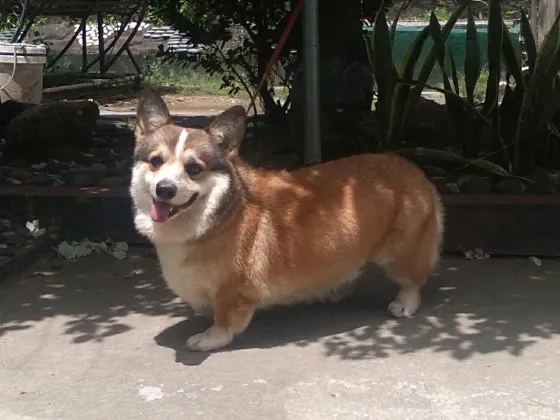
What it looks like. Trembling, panting, pacing, hiding, drooling, clinging, or escape attempts during fireworks, thunder, vacuum cleaners or gunshots. Some dogs bark at or "work" the noise.
Why. Noise sensitivity is the most common anxiety-related trait in dogs: 32 percent of 13,700 Finnish pet dogs had it (Salonen et al., 2020). The same study found large breed differences, pointing to a genetic share. Herding breeds are often described as more reactive to sound than some other groups, but sensitivity varies a lot between individual dogs and lines. Early experience, pain and health problems also play a part.
What to do.
- Vet first if the fear is new, worsening or severe. Pain and hearing changes can raise sensitivity, and a vet can discuss medication where appropriate.
- Make a safe place (quiet room or covered crate, familiar bedding, a chew) the dog can choose to use.
- Comfort is fine. Never punish fear.
- Reduce the noise. Close windows, play steady music, walk in daylight on firework nights.
- Desensitise slowly with a qualified behaviourist: recordings at very low volume while the dog is relaxed and eating, raised only when the dog is fully comfortable. Expect weeks to months.
When to get help. Panic that causes injury or escapes, days without eating, or fear spreading to new situations. A veterinary behaviourist can build a full plan.

Why does my Border Collie chase lights and shadows, spin or fixate?
What it looks like. Staring at reflections or shadows, snapping at invisible flies, chasing torch beams, spinning, pacing, or fixing on a ball or gate for hours. The dog is hard to interrupt.
Why. In the same Finnish study Border Collies had high rates of staring and of light and shadow chasing compared with many breeds (Salonen et al., 2020). A harmless stimulus sets off the stalking and eye reflex. Stress, boredom, too little rest, over-stimulating routines and laser or torch games can turn a quirk into a compulsive habit. Research on repetitive behaviour in dogs links it to stressful environments and early life experience (Tiira and Lohi, 2012 and related work).
What to do.
- Vet check first. Skin problems, anal gland discomfort, eye or neurological conditions and pain can all cause repetitive behaviour.
- No laser pointers or torch games. Dogs cannot catch light, so they end up frustrated.
- Remove the trigger. Close curtains when reflections move.
- Interrupt gently and offer an alternative: a scent search, a trick, a chew.
- Add rest, lower the daily intensity and add sniffing work. Never punish: it adds stress, which feeds the habit.
When to get help. If it takes up large parts of the day, the dog cannot be interrupted, it injures itself (licking or chewing skin raw), or it keeps building, see a vet, then a veterinary behaviourist. Earlier help gives better results, and no one can promise a cure.
Why is my Border Collie reactive on walks?
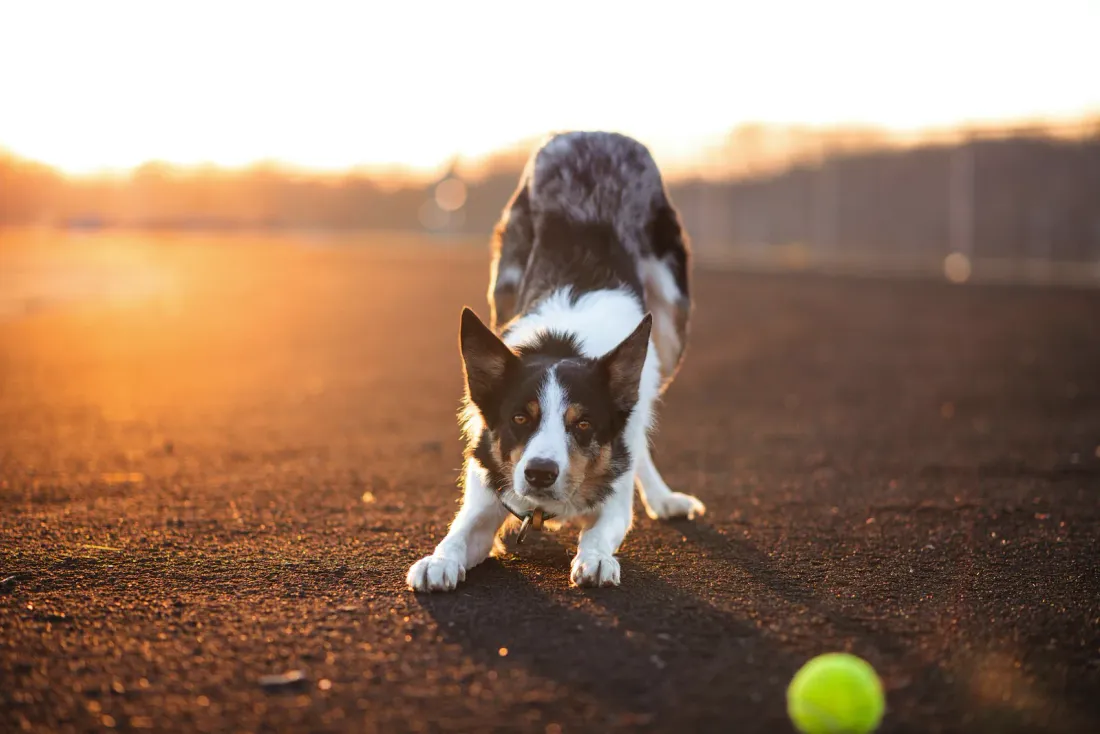
What it looks like. Barking, lunging or spinning at dogs, people, bikes or livestock, usually on the lead. It looks like aggression but is often frustration or fear.
Why. Frustration builds when the dog cannot reach what it wants to herd or chase. Fearful dogs bark to make the scary thing go away. Poor early socialisation adds nervousness, and practice makes reacting a habit.
What to do.
- Work under . Stay at a distance where the dog notices the trigger but still takes treats. Reward calm moments.
- Teach "look at me" and a u-turn at home first, then in easy places. Use the cue before the dog reacts.
When to get help. If the dog has bitten or is close to it, see your vet, then a qualified behaviourist. Avoid trainers who use choke chains, prong collars or shock collars.
Why is my Border Collie bored or destructive?
What it looks like. Chewed furniture, dug lawns, barking, stealing objects, or a dog that grows more demanding the more you do.
Why. A working-bred dog with spare time invents work. Under-stimulation is one cause; constant high-arousal games, which build a dog that cannot calm down, is the other.
What to do. Count the day's minutes of training, scent work, play, sniffing walks and rest, and rebalance. Add thinking tasks (food puzzles, scent games, tricks), rotate legal chews, teach mat rest daily, and use a pen, crate or closed door when you cannot watch.
When to get help. Destruction only when you are away, with drooling or escape attempts, suggests separation problems (next section). If the dog seems unwell, see your vet.
Can a Border Collie be left alone? Separation-related problems
What it looks like. Barking, howling, pacing, chewing doors or windows, house soiling, drooling or escape attempts soon after you leave. Some dogs shadow you around the house.
Why. The dog is distressed, not spiteful. Border Collies are very people-focused, so being left is hard for some. Risk factors include routine changes, rehoming, thin early socialisation, or never practising being alone. Not every Border Collie has this problem.
What to do.
- Practise short absences early. Start with seconds, return before the dog worries, build gradually.
- Leave calmly, with a chew or food puzzle after a rest.
- Film the dog and show your vet or behaviourist.
- Never punish on your return. The dog cannot link it to what happened hours earlier.
- Arrange cover (walker, friend) while you train.
When to get help. Real panic, self-injury or a worsening pattern: ask your vet for a referral to a qualified behaviourist. Gradual programmes, sometimes with veterinary support, work best.
What is over-arousal and how do you reduce it?
What it looks like. Zooming, barking, mouthing, grabbing and not listening, often after fast games, chasing or visitors.
Why. Border Collies were bred to react instantly to sheep. High excitement tips into frustration, nipping or fixation, and daily fetch or ball-launcher sessions can train a dog to stay "on".
What to do. Follow a hard game with a sniffing walk or mat session. Keep fast games to short bursts with clear start and stop cues. Play impulse-control games (below). Pay for calm and protect sleep.
When to get help. Arousal that tips into biting, or a sudden change: vet first, then a behaviourist.
How do you train a Border Collie?
When should socialisation start?
Scott and Fuller (1965) described a sensitive period for social learning from about three to twelve weeks of age. The American Veterinary Society of Animal Behavior supports careful socialisation in the first months, even before vaccinations are complete, because the behavioural risks of missing it outweigh the health risks of controlled exposure. The window starts closing around 12 weeks and is largely over by about 16 weeks, though learning continues.
Keep it calm, not flooding:
- Meet a few calm adults and well-behaved children at a distance the puppy chooses.
- Hear everyday sounds at low volume (vacuum, traffic, recorded fireworks).
- Watch bikes, prams and joggers from afar with treats (first step of chase control).
- Join a well-run puppy class that uses reward-based methods and lets puppies leave play at will.
- Handle paws, ears and mouth with treats.
Ask your vet how to socialise safely before vaccinations finish, for example by carrying the puppy to new places.
Which foundation cues come first?
Teach these in short sessions of two to five minutes, with food or play:
- Name response. Say the name, reward the look.
- Sit and down. Lure, reward, then add the word.
- Recall. Start indoors with a happy voice and high-value food.
- Settle on a mat. As above.
- Leave it and wait. Impulse control.
- Loose-lead walking. Reward position beside you, stop when the lead tightens.
- Touch. Nose to your hand, a base for tricks.
How do you build impulse control?
This is the central skill for a Border Collie owner.
- Wait at the door. Sit, open the door a crack, release with a word.
- Leave it. Treat in a closed hand, the dog backs off, reward from the other hand. Later put the treat on the floor.
- Wait for the bowl. Release only when the dog is calm.
- Toy on, toy off. Play, ask for "drop", give the toy back as the reward.
How do you train a reliable recall?
A recall is a habit built from thousands of rewarded repetitions.
- Use one unique word or whistle, and pay well with the best food or a game of tug.
- Start with few distractions and add them in small steps.
- Use a long line in open areas until recall holds around real distractions.
- Sometimes call, reward and release the dog back to play, so recall does not always end fun.
- Never punish a dog that returns, even late.
- In a working-type dog, chasing may beat food. Use a long line, strong outlets and distance practice. Some dogs will never be reliable off the lead near livestock, traffic or cyclists, and using a fenced space is no failure.
Which outlets suit Border Collies?
- Herding instinct tests and sheepdog lessons. In an AKC instinct test the dog needs no training; the judge looks for interest in stock and a tendency to fetch and drive without aggression. Lessons with a qualified instructor and calm animals teach controlled work.
- Agility. Fast and good for focus. Wait for physical maturity before jumping at height.
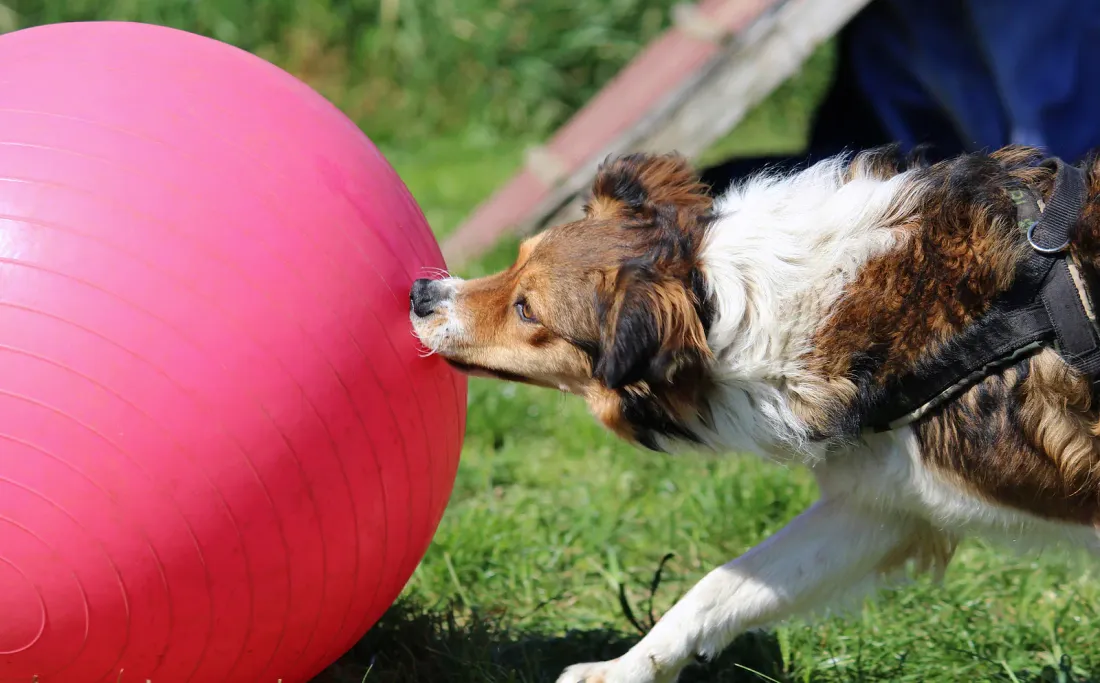
- Treibball. Developed in Germany in the 2000s by Jan Nijboer as an urban herding substitute: the dog drives large exercise balls into a goal on the handler's signals.
- Scent work and tracking. Calming, mentally tiring, suits all ages and fitness levels.
- Trick training and rally. Cheap, indoor, good for rainy days.
What mistakes should you avoid with a Border Collie?
- Adding more exercise instead of teaching rest.
- Endless ball throwing, laser pointers, torches and shadow games.
- Ignoring early signs of fear, fixation or reactivity.
- Skipping socialisation, or flooding a shy puppy.
- Punishing growls, which teaches the dog to hide warning signs.
- Expecting herding instinct to vanish without an outlet.
- Leaving children and dog unsupervised.
- Using aversive tools: shock, prong or choke collars.
- Training only in the garden, then expecting a recall at the park.
Why are shock collars and punishment not recommended?
The evidence points the other way. In a study of 92 companion dogs from seven Portuguese training schools, dogs from schools using aversive methods showed more stress behaviours, more time in tense or low states, more panting and higher post-training cortisol than dogs from reward-based schools, and were more "pessimistic" in a cognitive test (Vieira de Castro et al., 2020). A review of 17 studies concluded that aversive methods can harm physical and mental health and found no evidence that punishment works better than positive reinforcement (Ziv, 2017). In a trial of 63 dogs with poor recall, the authors found no evidence that e-collars are necessary and that positive reinforcement training carried fewer welfare risks (China et al., 2020). An owner survey linked frequent punishment to more behaviour problems (Hiby et al., 2004).
Border Collies read tone and body language closely, so harsh methods can add fear to a dog already prone to anxiety.
What does a sample weekly plan look like?
Two example weeks: one for a pet or show-line dog, one for a working-line dog. Both are for healthy adults. Adjust for age, health and your dog, and ask your vet before big changes.
| Day | Morning | Midday | Evening |
|---|---|---|---|
| Monday | Sniffing walk, 45 min | Two 5-minute sessions (, tricks) | Scatter feed, mat settle |
| Tuesday | Lead walk, loose-lead practice | Rest on mat | Indoor scent game, tug with rules |
| Wednesday | Off-lead time in a safe place, recall games | Food puzzle | Agility or foundation class |
| Thursday | Sniffing walk, 45 min | Two sessions (, new trick) | Quiet evening, chew |
| Friday | Lead walk, reactivity practice at distance | Rest on mat | or herding practice |
| Saturday | Long outing in a new place | Light rest | Scent search at home |
| Sunday | Easy walk | One short training session | Grooming and handling practice with treats |
Every day: two rest periods, one sniffing or scent activity, one short training session. Follow a high-energy day with a quieter one.
Working-line dogs are bred from trial and farm stock and selected for drive, so they usually need more structured work. More running alone rarely helps. Extra fetch or ball throwing tends to raise arousal instead of satisfying the dog. The goal is real tasks with clear starts and ends, plus planned rest. If the dog lives on a farm and works stock most days, the farm work replaces most of this plan.
| Day | Morning | Midday | Evening |
|---|---|---|---|
| Monday | Long sniffing walk, 60 min | Two 10-minute sessions (directional cues: left, right, stop, back) | Scatter feed, mat settle |
| Tuesday | Herding lesson with a sheepdog trainer, or treibball | Rest in crate or on mat | Short scent search, then chew |
| Wednesday | Off-lead run in a safe place, recall and stop-at-distance games | Food puzzle | Agility or obedience class |
| Thursday | Lead walk with loose-lead and calm passing practice | Two sessions (impulse control, new trick chain) | Quiet evening, chew |
| Friday | Scent work: hide searches on a walk | Rest | Treibball, or practice of herding cues on balls |
| Saturday | Hill walk or long hike in a new place | Long rest | Scent search at home |
| Sunday | Easy walk only | Rest day: no formal training | Grooming and handling practice with treats |
Points that matter more for working lines:
- Rest is part of the plan. A dog that never stops is not a happy dog. Teach the settle early and protect at least one quiet day a week.
- Give the instinct a legal outlet. A herding instinct test or regular lessons with a sheepdog trainer give the drive a real target. Without one, it often goes into cars, bikes, children or other dogs.
- Train thinking, not only stamina. Directional cues, stop at distance and searching tire the brain, which is the part that drives problem behaviour.
- Watch for . Panting, whining, staring and failing to settle after activity mean the week is too busy, not too quiet. Swap one active session for rest.
- Talk to the breeder or a sheepdog trainer. They know what the dog's lines were bred for and how much work similar dogs need.
Frequently asked questions
Are Border Collies good family dogs?
Some are, with active owners, early training and supervision around young children. They suit homes that are empty all day poorly.
At what age do Border Collies calm down?
No fixed age. Many steady after adolescence, often around two years, if taught to rest and given outlets.
Can a Border Collie live in a flat?
Possible for a committed owner who gives several hours of varied activity a day, plus training and rest.
Is a Border Collie a good first dog?
It can be, but it is demanding. Plan for classes, time and patience, and judge the individual dog, not the breed alone.
When should I ask for professional help?
When behaviour is sudden, severe, worsening or involves biting, panic, self-injury or repetitive actions you cannot interrupt. Start with the vet to rule out pain or illness, then ask for a qualified behaviourist who uses methods. No one can guarantee a cure, but early help improves the odds.
Sources (11)
- Casey, R. A., Loftus, B., Bolster, C., Richards, G. J., Blackwell, E. J. (2014). Human directed aggression in domestic dogs (Canis familiaris): occurrence in different contexts and risk factors. Applied Animal Behaviour Science.
- China, L., Mills, D. S., Cooper, J. J. (2020). Efficacy of dog training with and without remote electronic collars vs. a focus on positive reinforcement. Frontiers in Veterinary Science.
- Hiby, E. F., Rooney, N. J., Bradshaw, J. W. S. (2004). Dog training methods: their use, effectiveness and interaction with behaviour and welfare. Animal Welfare.
- Salonen, M., Sulkama, S., Mikkola, S., Puurunen, J., Hakanen, E., Tiira, K., Araujo, C., Lohi, H. (2020). Prevalence, comorbidity, and breed differences in canine anxiety in 13,700 Finnish pet dogs. Scientific Reports.
- Scott, J. P., Fuller, J. L. (1965). Genetics and the Social Behavior of the Dog. University of Chicago Press.
- Tiira, K., Lohi, H. (2012 and related papers). Studies of compulsive and repetitive behaviour in dogs. University of Helsinki.
- Vieira de Castro, A. C., Fuchs, D., Morello, G. M., Pastur, S., de Sousa, L., Olsson, I. A. S. (2020). Does training method matter? Evidence for the negative impact of aversive-based methods on companion dog welfare. PLoS ONE.
- Ziv, G. (2017). The effects of using aversive training methods in dogs: a review. Journal of Veterinary Behavior.
- American Veterinary Society of Animal Behavior. Position statement on puppy socialization.
- American Kennel Club. Herding: getting started and the herding instinct test.
- The Kennel Club (UK). Border Collie breed information (exercise requirements).