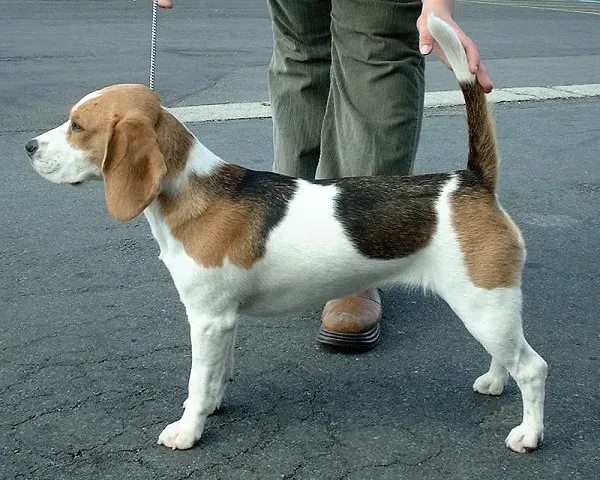
It stands about 33 to 41 cm tall, weighs a median 18 kg in UK vet records, and lives roughly 12 to 15 years by project data (UK vet records give a median closer to 11 to 12). The breed is friendly, curious and sociable, with a nose that overrides most other instructions. It suits active households that can give about an hour or more of exercise a day, a secure garden and patient training, and it copes poorly with long hours alone.
Beagle quick facts
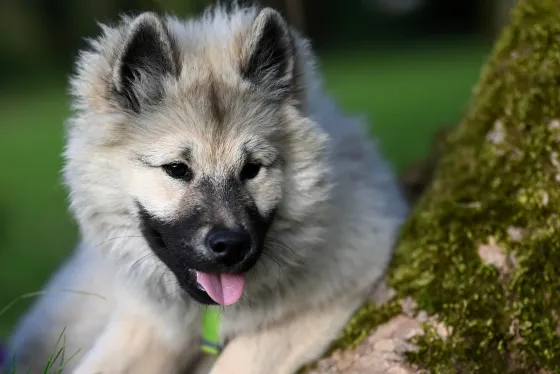 Related breedGerman Spitz1400 to 1899 · Germany
- Closest DNA relatives
- English Foxhound, Redbone Coonhound, Bloodhound, Otterhound
- Descendant breeds
- Beagle-Harrier, Teddy Roosevelt Terrier, Plummer Terrier, Puggle (a modern cross)
- Country of origin
- United Kingdom (England, Great Britain)
- Period of development
- About 1400 to 1890 (project data, medium confidence); modern breed shaped in the 1800s
- Type
- Scent hound (FCI Group 6, scent hounds and related breeds, standard no. 161; AKC Hound Group; UK Kennel Club Hound Group)
- Varieties in the AKC standard
- 13 inch (up to 33 cm) and 15 inch (over 33 cm, up to 38 cm)
- Height
- FCI 33 to 40 cm; UK Kennel Club 33 to 41 cm; AKC up to 38 cm
- Weight
- Median adult 18.2 kg in a UK VetCompass sample (males 19.7 kg, females 16.6 kg)
- Life span
- Project data 12 to 15 years. UK VetCompass median age at death 11.3 years
- Family (DNA)
- Scent Hound (Parker et al. 2017, strong support)
Name and origin
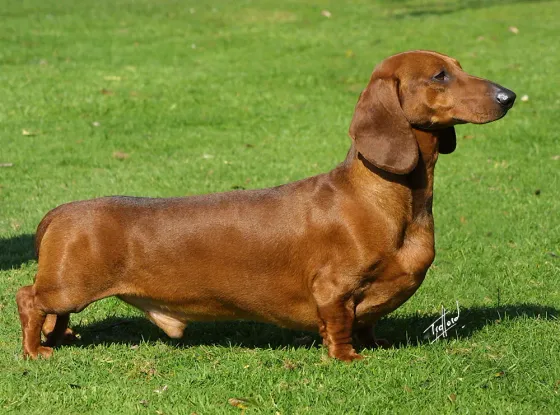
 Related breedKurī1250 to 1300 · New Zealand
Where the word "beagle" comes from
Nobody knows. The main theories, in no order of strength:
- French "bee gueule" or "begueule". Meaning "open throat" or, more loosely, "loudmouth", for the breed's carrying voice. The knowledge base and Wiktionary give this as a possible source.
- "Beag" meaning small. Proposed from Gaelic, Old English or Welsh, for the dog's size. The word "beag" does mean "small" in Gaelic, but a link to the dog's name is a guess.
- "Beugler" or "begele". French "beugler", to bellow, and a German word for scolding have both been suggested. These are the weakest ideas.
Wiktionary traces the English word to Middle English "begel", of uncertain origin. Pick whichever you like, because no theory is proven.
English hunting hounds
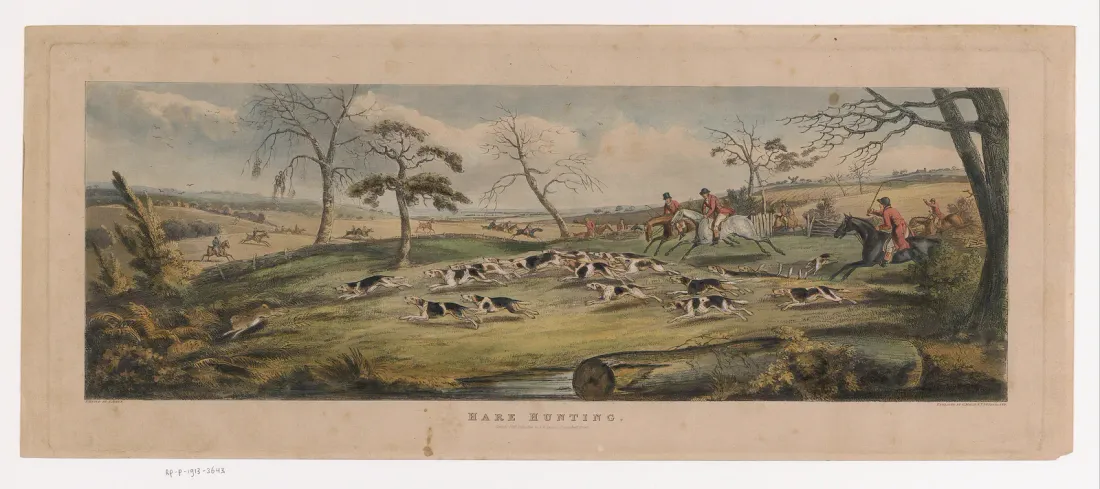
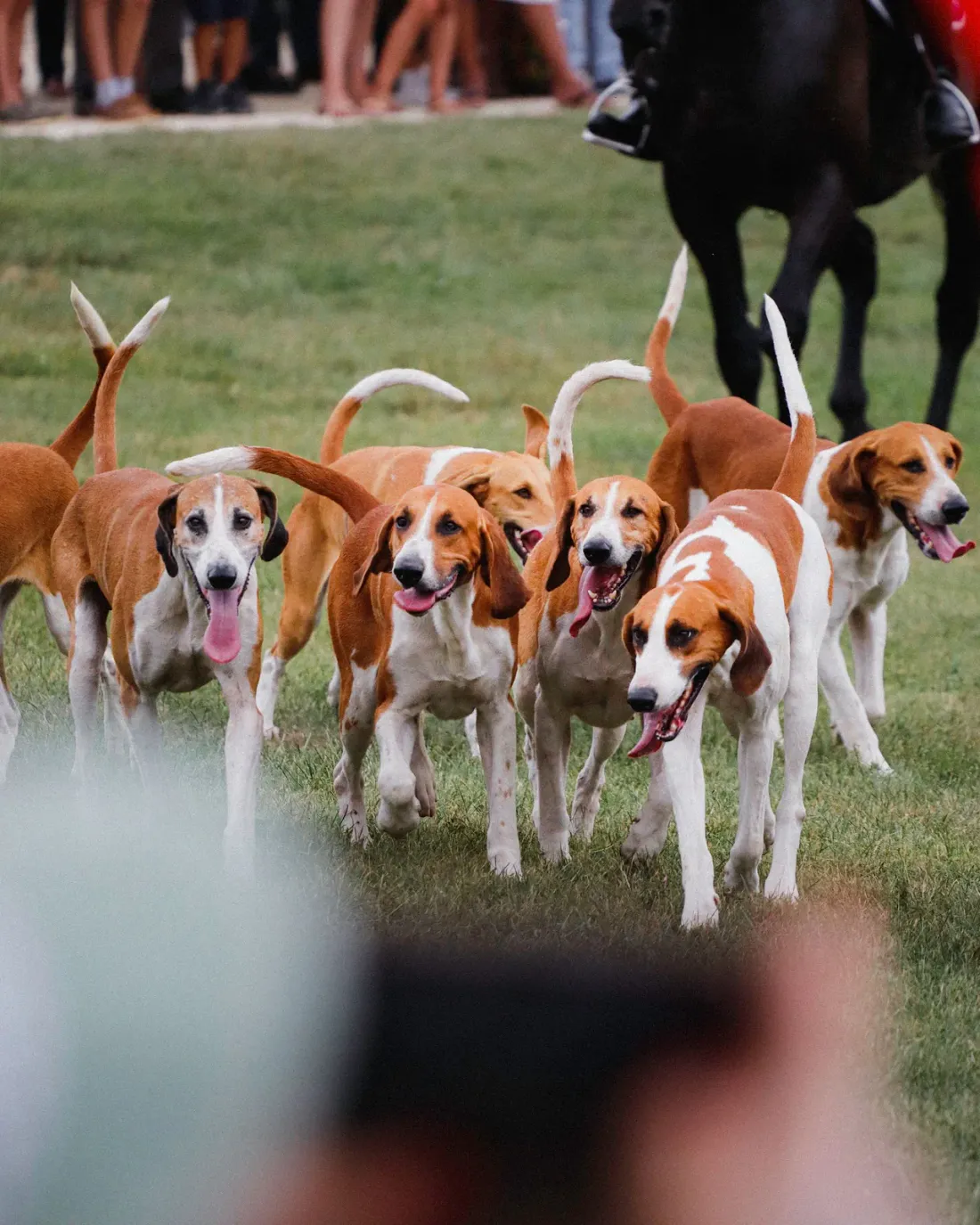
The Beagle belongs to a long line of English hounds used to hunt hare, and sometimes fox and rabbit, on foot. Small hounds of this kind are recorded for centuries, so the project dates the type to about 1400. These dogs were hunted in packs. The hounds follow the scent, a trait called "hunting by nose", and bay when they are close, so hunters can keep pace on foot. The breed's relatives in the project data are other pack hounds: the Southern Hound (a slow, heavy, deep-voiced hunting hound now extinct), the Talbot (an old white or pale hound, also extinct) and the North Country Beagle (an extinct northern type). All three are listed as likely ancestors, with medium confidence. The writer Youatt suspected Harrier blood in the breed, but this is not documented, so the project data rates it low.
History
 Same eraPoodle1400 to 1874 · France
Elizabeth I and the Pocket Beagle
Tudor England had very small hounds. Queen Elizabeth I is said to have kept "singing beagles", and a tiny type later called the Pocket Beagle is recorded from this period. Standards for it were still being written as late as 1901, and the type is now extinct, although some breeders have tried to rebuild it. Treat the stories of tiny glove-sized hounds with caution: they come from later writers, not from measured records.
The Honeywood pack and the modern breed
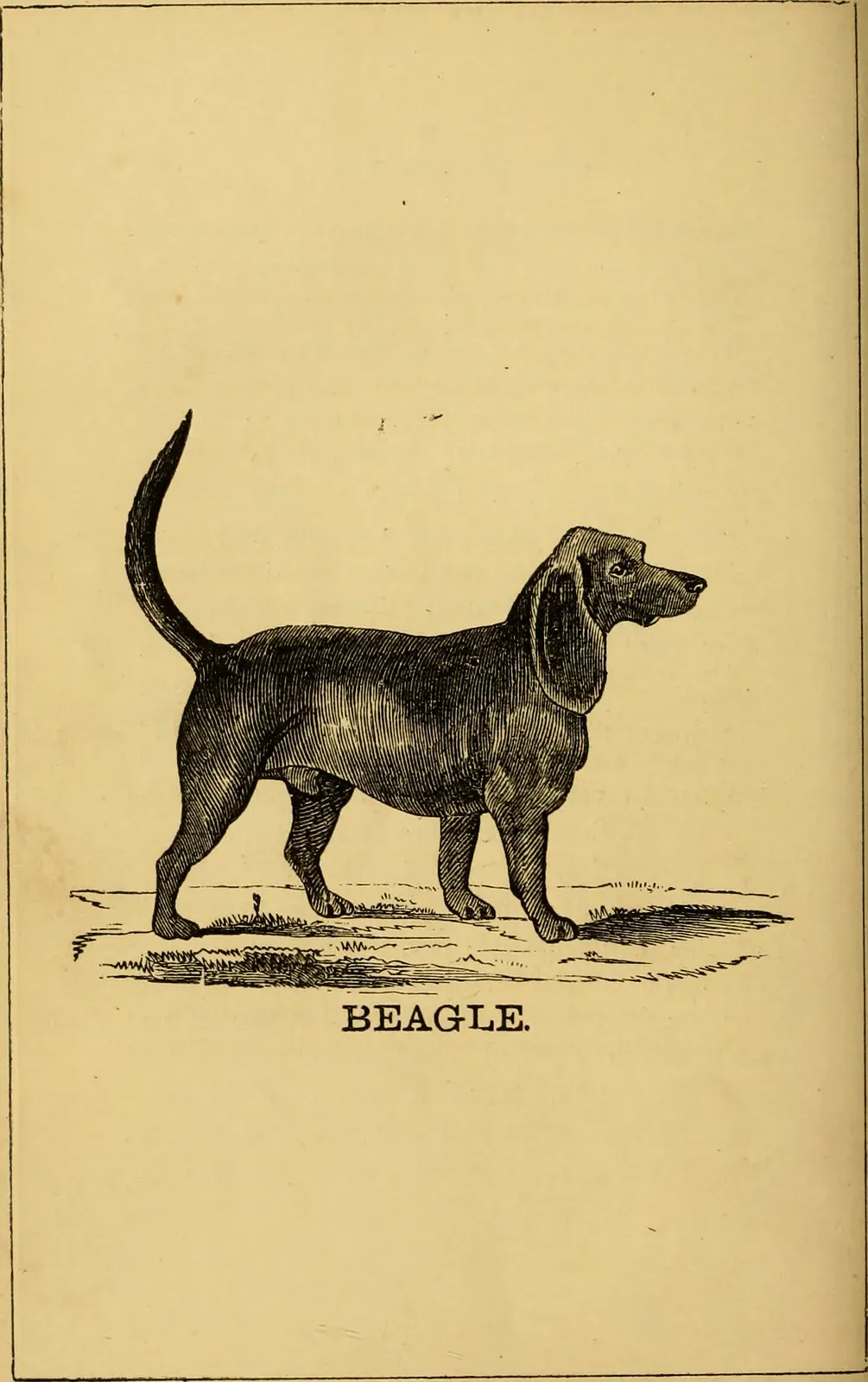
The modern Beagle is usually traced to the pack of the Reverend Phillip Honeywood in Essex, formed in the 1830s. John Mills wrote in 1845 that Honeywood's hounds were small, about 25 cm at the shoulder, and pure white. North Country Beagles were strongly represented in that pack. Honeywood bred for hunting ability. Thomas Johnson is credited with refining the type for appearance as well as work, and two strains came from this period: a smooth coat and a rough coat. The rough-coated strain died out.
To America
General Richard Rowett of Illinois imported dogs from England in the early 1870s and began breeding them. Rowett's hounds are believed to have been the models for the first American standard, written in 1887 by Rowett, L. H. Twadell and Norman Ellmore. The AKC recognised the breed in 1885, and the Beagle Club was founded in England in 1890 with its own standard.
Kennel club recognition
| Year | Event |
|---|---|
| About 1830s | Honeywood pack formed in Essex |
| 1885 | AKC recognises the Beagle |
| 1887 | First American standard written |
| 1890 | The Beagle Club founded in England; first English standard |
The FCI lists the Beagle as standard no. 161 (definitive), with Great Britain as country of origin, in Group 6. The Beagle is also recognised by the UK Kennel Club and the AKC (Hound Group in both).

Ancestors, descendants and relatives
 Same familyStandard Schnauzer1400 to 1880 · Germany
Ancestors. The Southern Hound, North Country Beagle and Talbot are listed with medium confidence. The Harrier is listed as crossed with the Beagle, with low confidence.
Descendants. Several breeds list the Beagle as a parent. The Beagle-Harrier is a French breed from Beagle and Harrier stock. The Teddy Roosevelt Terrier, Plummer Terrier and Smooth Fox Terrier all have Beagle in their recorded background, with the Beagle's contribution varying by breed. The Puggle is a modern designer cross of Beagle and Pug, not a breed with a standard.
Sister breeds. The English Foxhound, the Staghound and the extinct Southern Hound and North Country Beagle.
What DNA says
A 2017 study by Parker and colleagues (Cell Reports) analysed 1,346 dogs from 161 breeds and sorted them into 23 supported clades. The Beagle sits in the Scent Hound clade with strong support. The study also measured shared : long stretches of identical DNA inherited from common ancestors. The more (Mb) two breeds share, the stronger the sign of crossing or shared founders. It cannot tell which way genes flowed.
Source: Parker et al. 2017, as recorded in this site's breed database.
The English Foxhound tops the list, which fits the old description of the Beagle as a small Foxhound. The Redbone Coonhound is an American breed, so its high score points to hound lines that crossed the Atlantic with English hunting dogs. Lower values for the Basset Hound and the Petit Basset Griffon Vendéen show that these shorter-legged scent hounds are more distant cousins.
Sister breeds · 4
- Staghound1200 to 1500
- Southern Hound1300 to 1700
- North Country Beagle1500 to 1800
- English Foxhound1650 to 1800
Descend from it · 5
- Smooth Fox TerrierUnited Kingdom
- Beagle-HarrierFrance
- Teddy Roosevelt TerrierUnited States
- Plummer TerrierUnited Kingdom
- PuggleUnited States
- English Foxhound61.0 Mb 2.5%
- Redbone Coonhound56.3 Mb 2.3%
- Bloodhound50.0 Mb 2.1%
- Otterhound44.8 Mb 1.9%
- Basset Hound18.9 Mb 0.8%
- Petit Basset Griffon Vendéen14.7 Mb 0.6%
Source: Parker et al. 2017. Percent of the whole genome.
| Breedwith Beagle | Shared DNA with Beagle (Mb)Shared DNA (Mb) |
|---|---|
| English Foxhound | 61.0 |
| Redbone Coonhound | 56.3 |
| Bloodhound | 50.0 |
| Otterhound | 44.8 |
| Basset Hound | 18.9 |
| Petit Basset Griffon Vendéen | 14.7 |
The breed standard
A breed standard is the written ideal a kennel club judges dogs against. All three clubs describe a compact, sturdy hound. The AKC calls the ideal a miniature Foxhound, "solid and big for his inches", with the look of a hound that can last in the chase.
Two varieties in the AKC standard
The AKC standard divides the breed into two varieties by height: the 13 inch Beagle, up to 13 inches (33 cm) at the withers, and the 15 inch Beagle, over 13 and up to 15 inches (38 cm). A hound over 15 inches is disqualified in the AKC ring. These are varieties in the standard, which judges class separately, not separate breeds. The FCI and UK Kennel Club standards give a single height range instead.
| Trait | FCI (no. 161) | AKC | UK Kennel Club |
|---|---|---|---|
| Height | 33 to 40 cm | 13 inch variety up to 33 cm; 15 inch variety over 33 up to 38 cm | 33 to 41 cm |
| Weight | Not verified for this draft | Not stated in the standard | Not verified for this draft |
| Coat | Short, dense, weatherproof | Close, hard, medium length | Short, dense, weatherproof |
| Colours | Any recognised hound colour except liver | Any true hound colour | Any recognised hound colour except liver |
| Head and ears | Broad skull, long ears set low, rounded at the tip | Same general type | Same general type |
| Tail | Carried gaily, never over the back; white tip common | Carried gaily, white tip | Carried gaily, white tip |
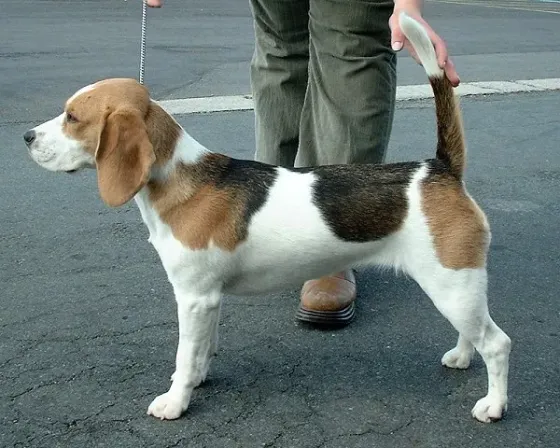
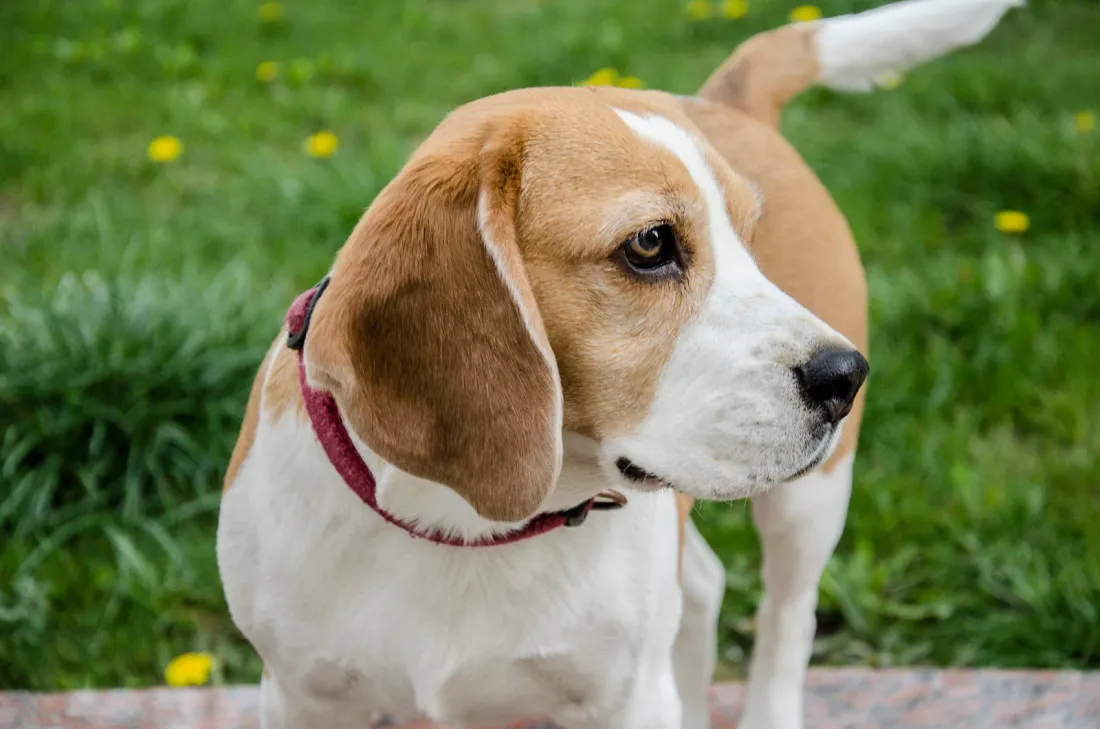
The standards agree on the type: a strong, square hound with a broad skull, a straight muzzle, large soft brown or hazel eyes and long, low-set ears. Tricolour (black, tan and white) is the best-known pattern, along with lemon, red and white and other hound colours. Wording differs between clubs, so the table summarises the standards and does not quote them.
A median adult weight of 18.2 kg from the UK VetCompass sample of 19,906 Beagles gives a practical figure, with males about 3 kg heavier than females (O'Neill et al., Canine Medicine and Genetics, 2024). Weight is covered further in the health section.
Temperament
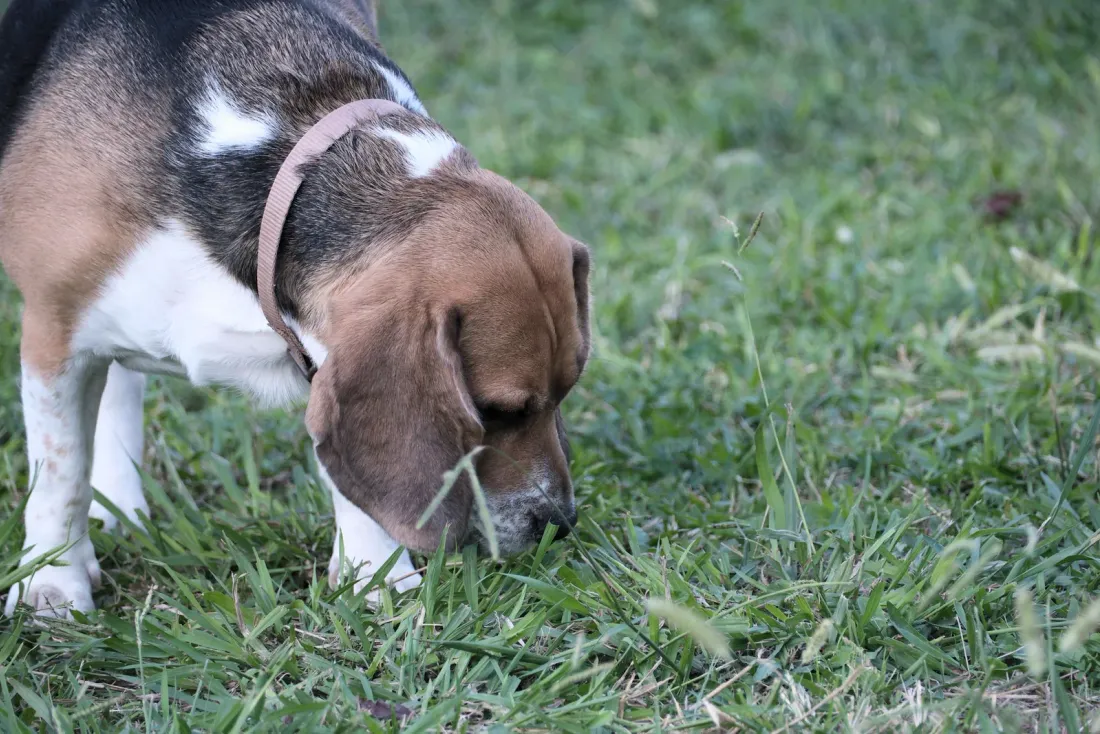
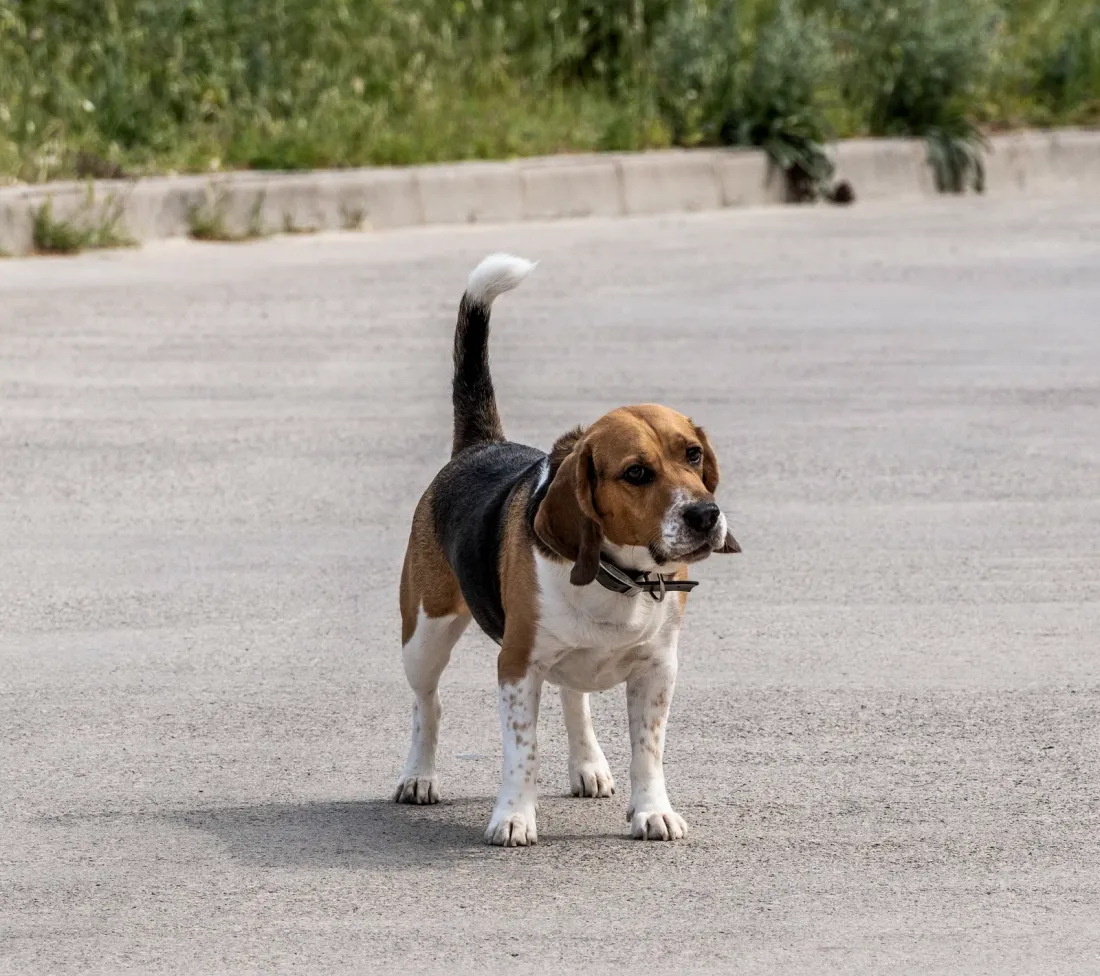
The AKC describes the Beagle as friendly, curious and merry. The breed was built to work in a pack, so most Beagles are sociable with people and other dogs and do not guard well. Most are food-motivated. They are good-natured with children when well socialised, though a young Beagle is energetic and can be clumsy around small children.
The nose runs the dog. A Beagle that picks up a scent can stop responding to calls entirely, which is why recall is the hardest part of training and why a secure fence matters. This is a trait of hounds that hunt by scent, not stubbornness for its own sake. Short, rewarding training sessions with food work better than repetition and pressure.
Temperament varies by line. Working pack lines and show or companion lines can differ in energy, and early socialisation matters in every line.
Behaviour
- Baying and howling. The Beagle was bred to give tongue on a trail, and it has a loud, carrying voice. A bored or lonely Beagle often howls or barks. Neighbours in flats and terraced houses are the usual victims.
- Following the nose. Sniffing walks are a need, not a luxury. A short lead walk with no sniffing time is poor exercise for a scent hound.
- Food drive. Beagles are quick to steal and raid bins, which links to the breed's tendency to gain weight.
- Digging and escaping. Fence gaps and gates are tested. Many Beagles will go under or over a low barrier when a scent trail beckons.
- Pack instinct. Many are happiest with company and show distress when left for long periods.
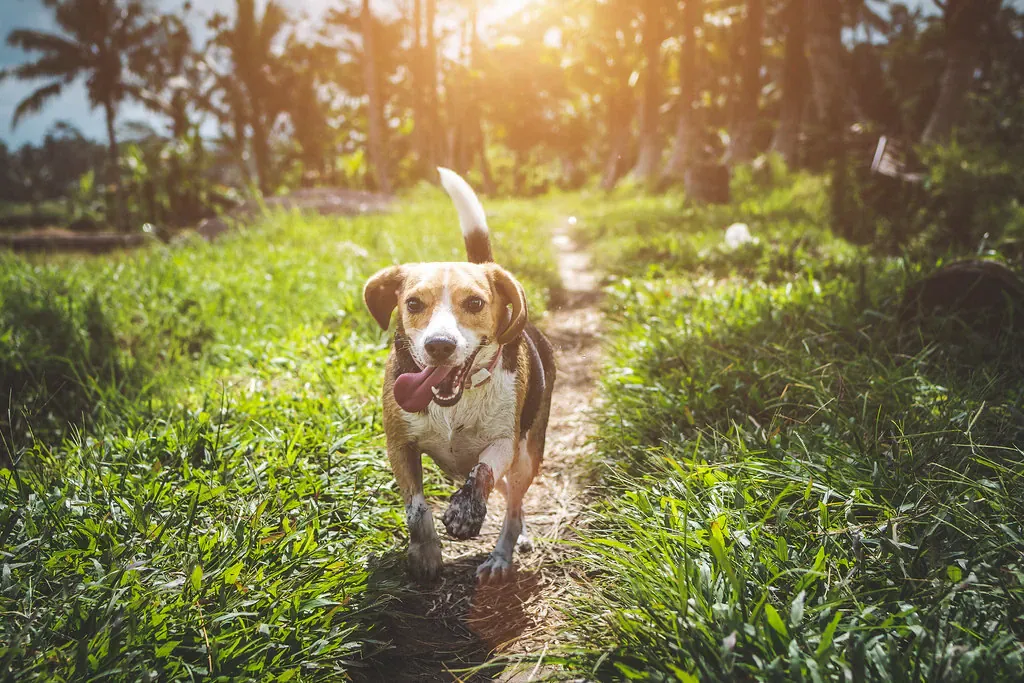
Working Beagles
Detection work and the Beagle Brigade
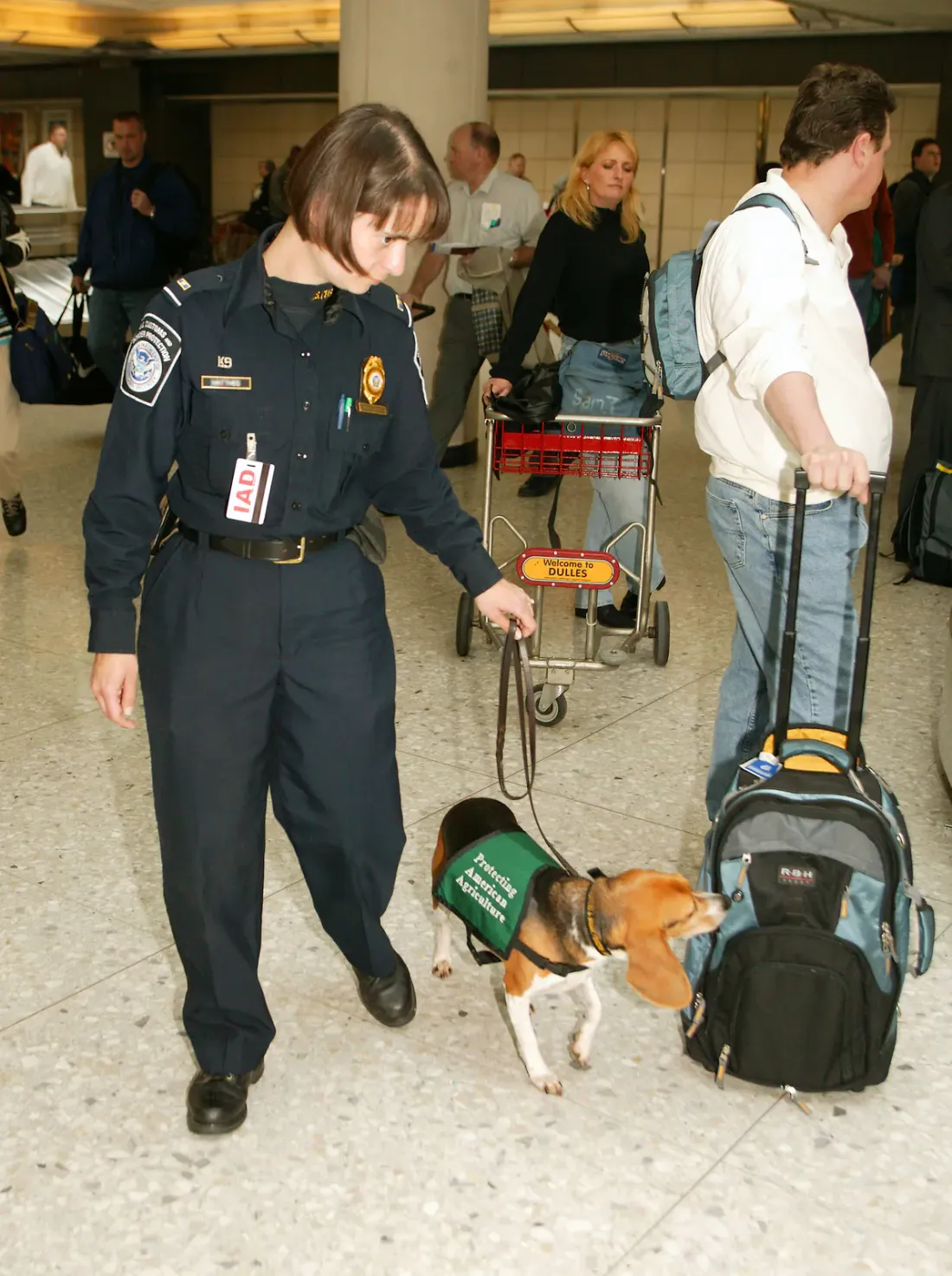
In 1984 the US Department of Agriculture started a detector dog programme at Los Angeles International Airport, and its dogs became known as the Beagle Brigade. The programme began with one dog and one handler, searching luggage and carry-on bags from international flights for prohibited fruit, plants and meat that could carry crop or livestock pests and diseases. It later grew to about 120 beagles at 21 international airports (USDA APHIS, as reported by US Customs and Border Protection history pages). The dogs were chosen for a strong food drive and a friendly, non-threatening manner around travellers, which matters in a crowded terminal.
The breed's reputation for the best nose is partly an assumption. A 2024 genetic comparison of olfaction in dogs and wild canids (a preprint, not yet peer reviewed in the version found for this draft) reported that scent hounds did not have more functional olfactory receptor genes than several other breed groups. The Beagle's strength as a detector dog may owe as much to trainability, motivation and size as to its nose.
Hunting
Packs of Beagles are still used to hunt hare and rabbit in several countries, and in the United States beagling with small packs and field trials continues under AKC rules. The "beagling" tradition in England follows the hounds on foot.
Laboratory research
Beagles are the breed most often used when dogs are used in research and safety testing. The reasons usually given are practical: a medium-small size, a calm and sociable nature that makes handling easier, and a long history of earlier data that new studies can be compared against. According to USDA figures, 42,411 dogs were held or used for research, testing, teaching or experimentation in the United States in 2024, across all breeds. A number of US states now have laws requiring that research dogs be offered for adoption when a study ends, and adoption schemes for laboratory beagles exist in several countries. Whether animals should be used in research is a contested question, and this article takes no side on it. Owners adopting a former laboratory Beagle may find that the dog needs time to learn about stairs, grass, household noises and walking on a lead.
Health
Most Beagles live healthy lives. The conditions below are what responsible breeders screen for and what owners can watch for, and most are manageable with routine care. Figures come from named studies. Where no study gives a prevalence, the table says so instead of guessing.
The best UK figures come from the VetCompass programme at the Royal Veterinary College. O'Neill and colleagues (Canine Medicine and Genetics, 2024) studied 19,906 Beagles under primary veterinary care in the UK, 0.88 percent of a 2.25 million dog sample, and recorded 322 deaths. Median age at death was 11.28 years. Neoplasia (cancer) was the leading cause of death at 19.26 percent of deaths, about 1 in 5.
| Condition | What it is | How common | What helps |
|---|---|---|---|
| Obesity | Carrying excess body fat, which strains joints and shortens life | 24.27 percent, about 1 in 4 Beagles (VetCompass, O'Neill et al. 2024) | Measured meals, treats counted in the daily ration, regular weigh-ins at the vet |
| Dental disease | Plaque and gum disease, tooth loss | Periodontal disease 17.78 percent, about 1 in 6; dental disorders as a group 21.48 percent, about 1 in 5 (VetCompass 2024) | Daily tooth brushing, dental checks |
| Ear infection (otitis externa) | Inflammation of the outer ear canal, common in dogs with long, low ears | 11.18 percent, about 1 in 9 (VetCompass 2024) | Routine ear checks, vet-advised cleaning, early treatment |
| Anal sac impaction | Blocked scent glands near the anus, causing scooting | 10.59 percent, about 1 in 9 (VetCompass 2024) | Vet or groomer expression if recurrent, fibre in diet |
| Overgrown nails | Nails that have not been worn down | 11.61 percent, about 1 in 9 (VetCompass 2024) | Regular trimming |
| Lafora disease | Inherited late-onset epilepsy with jerking, light sensitivity and memory loss; . A 12-nucleotide repeat expansion in the NHLRC1 gene | In one commercial laboratory's tests of 512 Beagles (Dec 2017 to Apr 2018) 1.9 percent, about 1 in 53, were affected and 22.9 percent were . Tested dogs are not a random sample | DNA test for NHLRC1 repeat expansion; test both parents before breeding |
| Musladin-Lueke syndrome (MLS) | Inherited stiff skin and tight joints; recessive. A founder mutation in ADAMTSL2 | Frequency in the breed unknown (published reports) | DNA test; breed carrier to clear only |
| Intervertebral disc disease | Disc problems in the spine of long-backed dogs, causing pain or weakness | Beagles are listed as a breed prone to it; no prevalence figure verified for this draft | Healthy weight, avoiding repeated jumping from height, prompt vet check for back pain |
| Epilepsy (idiopathic) | Recurrent seizures with no other cause found | Reported as more frequent in the breed; no prevalence figure verified for this draft | Vet diagnosis; medication when needed |
| Hypothyroidism, cherry eye | Underactive thyroid; a prolapsed gland of the third eyelid | Commonly reported in Beagles; no prevalence figure verified for this draft | Blood test for thyroid; vet treatment for cherry eye |
Weight deserves attention. About one in four UK Beagles is recorded as obese, and Beagles will eat almost anything. A healthy Beagle has a visible waist and ribs that can be felt under a thin layer of fat.
Life span
Project data gives 12 to 15 years. The UK sample's median age at death of 11.28 years is a mix of all causes and includes dogs lost young, so many individual Beagles live longer. A healthy weight is the single most useful factor an owner controls.
Living with a Beagle
The ratings below follow from the breed standard, the sources above and general kennel club guidance. Where evidence is thin, the rating says "Varies".
| Area | Rating | Reason |
|---|---|---|
| Exercise per day | Medium to High | About an hour or more of walking and sniffing; more for young adults (varies by line) |
| Training needs | High | Food-motivated but easily distracted by scent; recall needs years of work |
| Grooming | Low | Short coat; weekly brushing is enough |
| Shedding | Medium | Short hairs shed all year round |
| Barking and howling | High | Bred to give tongue on a trail |
| Time alone | Poor | Pack dog; often distressed when left for long periods |
| Children | Good | Sociable and sturdy; supervise young children and teach gentle handling |
| Other dogs | Good | Bred to hunt in packs |
| Cats and small pets | Fair | A hunting hound; varies by dog and early exposure |
| Flat living | Fair | Possible only if the howling is managed and exercise is met |
| Heat tolerance | Fair | Not a flat-faced breed; take normal precautions |
| Cold tolerance | Good | Short but dense, weatherproof coat |
| First-time owner | Fair | Friendly, but demands training patience and a secure garden |
A great fit if
- You enjoy long walks and don't mind a dog that stops to sniff everything.
- You have a securely fenced garden and a neighbourly setting for some noise.
- Someone is home for much of the day, or a trusted dog walker can visit.
- You can keep to measured portions and refuse the puppy-eyes routine.
Think twice if
- You want a dog that comes back every time off the lead.
- You live in thin-walled housing with noise-sensitive neighbours.
- The house is empty for most of every weekday.
- You want a low-effort dog that doesn't mind being left.
Before you get one
- Health tests to ask a breeder for. Ask for the NHLRC1 DNA test result for Lafora disease for both parents and the ADAMTSL2 DNA test result for MLS. A reputable breeder will share them and explain them.
- Puppy or adult rescue. Breed rescues exist in many countries, and adult Beagles, including retired laboratory dogs, often need homes. An adult's energy and temperament are easier to judge than a puppy's.
- First year. Expect chewing, toilet-training setbacks, and an adolescent phase in which recall gets worse before it gets better. Start recall training with a long line early, and keep the garden fence secure.
Similar breeds to consider
- The Basset Hound: a calmer, lower scent hound with a smaller exercise need.
- The English Foxhound: a larger pack hound for owners with more space and time.
- The Petit Basset Griffon Vendéen: a rough-coated scent hound with a similar cheerful nature.
- The Beagle-Harrier: a slightly larger hound of Beagle and Harrier stock.
Beagle fun facts
- Queen Elizabeth I is said to have kept "singing beagles" of a tiny Pocket Beagle type, a type that is now extinct.
- The Honeywood pack behind the modern breed stood only about 25 cm at the shoulder and was pure white, according to an 1845 description.
- The AKC standard splits the breed into two classes by height, 13 inch and 15 inch, and disqualifies any Beagle over 15 inches.
- The USDA Beagle Brigade began in 1984 with a single dog at Los Angeles International Airport.
Frequently asked questions
Are Beagles good family dogs?
Often yes. They are sociable, sturdy and playful. They need exercise, company and supervision around very young children, and they are noisy.
How long do Beagles live?
Project data gives 12 to 15 years. The UK sample found a median age at death of 11.28 years.
How big is a Beagle?
About 33 to 41 cm depending on the club. The AKC has a 13 inch variety and a 15 inch variety. UK vet records give a median adult weight of 18.2 kg.
Do Beagles bark and howl a lot?
Yes. They were bred to give tongue on a trail. Training, exercise and company reduce it, but the voice stays.
What health problems do Beagles have?
The most common in UK records are obesity, dental disease, ear infections and anal sac problems. Inherited conditions include Lafora disease and Musladin-Lueke syndrome, both testable by DNA.
How much exercise does a Beagle need?
About an hour or more a day, including time to sniff. Needs vary by age and line.
Why is it called a Beagle?
Nobody knows. Theories include French "bee gueule" (open throat) and "beag", meaning small.
What is the Beagle Brigade?
A USDA programme, begun in 1984, that uses Beagles to find prohibited fruit, plants and meat in travellers' bags at airports.
Read next
Sources (15)
- American Kennel Club, Beagle breed standard and breed information.
- Beagle Club (UK), history and standard information.
- Fédération Cynologique Internationale, Beagle, standard no. 161.
- Genomia, Lafora epilepsy statistical overview of Beagle test results, 2018 (commercial laboratory data).
- National Beagle Club (US), history and standard.
- O'Neill D.G. et al., "Beagles kept as companion animals in the UK: demography, disorders and mortality", Canine Medicine and Genetics, 2024 (VetCompass, Royal Veterinary College).
- Parker H.G. et al., "Genomic analyses reveal the influence of geographic origin, migration, and hybridization on modern dog breed development", Cell Reports, 2017.
- The Kennel Club (UK), Beagle breed standard.
- US Customs and Border Protection, history timeline 1984; USDA APHIS Beagle Brigade information.
- USDA animal research statistics for dogs, 2024, as reported by animal welfare organisations.
- Wikipedia, "Beagle" and "Beagle Brigade" (used for dates and summaries, checked against the other sources listed).
- Wiktionary, "beagle".
- Project knowledge base, breed records and Parker 2017 shared-haplotype table (this site).
- Published case reports on NHLRC1 repeat expansion in Beagles with Lafora disease, and on Musladin-Lueke syndrome (ADAMTSL2) in Beagles.
- Biomedical preprint (bioRxiv, 2024), genetic and anatomical determinants of olfaction in dogs and wild canids.